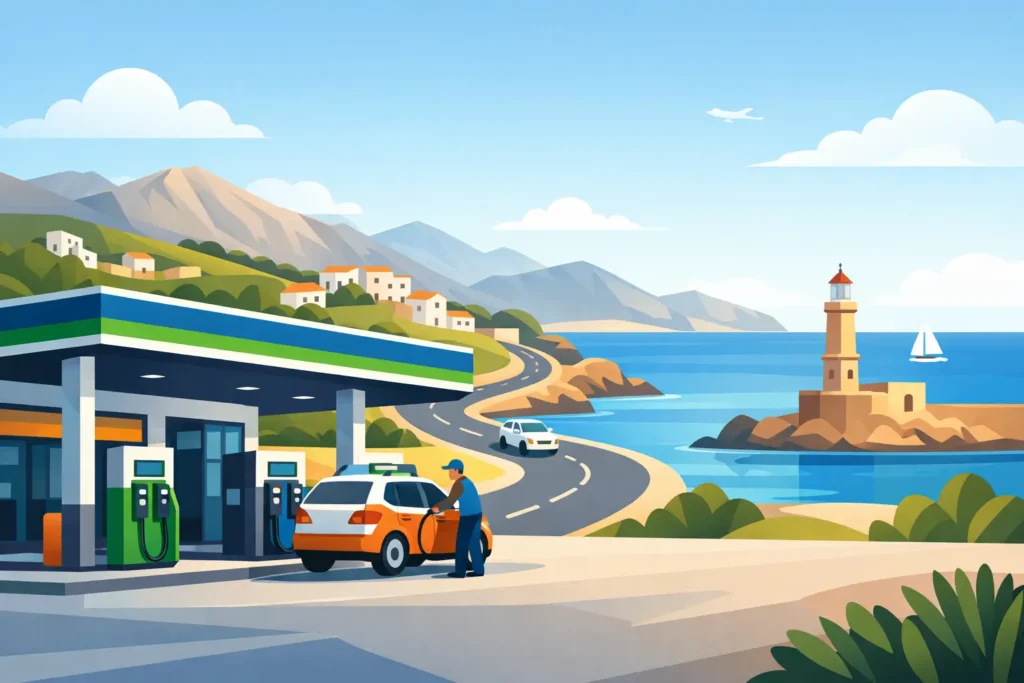
You land in Crete, collect your car, set the sat nav for a beach or mountain village, and then the fuel light appears sooner than expected. This is usually the moment people start asking about fuel stations in Crete, how they work, whether they are self-service, and if they can pay by card. The good news is that refuelling on the island is straightforward once you know the basics.
Crete is easy to drive if you keep things simple. Fuel stations are common around towns, airports and main roads, but they are less predictable in small villages and remote southern areas. If you like certainty and want to avoid unnecessary stress, it helps to understand how local stations operate before you are running low.
Fuel stations in Crete: how they work in practice

Most fuel stations in Crete are attended. That means you usually stay in the car or step out briefly while a member of staff fills the tank for you. This is different from parts of Europe where self-service is standard. In Crete, the normal routine is very direct: pull up beside a pump, tell the attendant what fuel you need and how much, and they handle the rest.
In many cases, you can simply say you want the tank full. If you only want a specific amount, give the amount in euros. Staff at stations in tourist areas often speak enough English for a basic fuel transaction, so this is rarely complicated.
Once the fuel is added, you pay at the pump or inside the small cashier area, depending on the station. Some modern sites are set up more like mini service stations with snacks, drinks, screen wash and car supplies. Others are small local forecourts with just a couple of pumps and a cashier window. Both are normal.
This attended setup is useful for visitors because it reduces mistakes at the pump. That said, the main responsibility still sits with the driver. Make sure you know which fuel your car uses before refuelling.
Which fuel should you ask for?

The two main options are unleaded petrol and diesel. Unleaded is commonly labelled as 95 or 100 octane, while diesel is usually marked clearly as diesel or πετρέλαιο κίνησης at some local stations. Most standard hire cars in Crete use unleaded petrol, but not all do. Never assume.
Check the key tag, hire paperwork or fuel cap before you say anything to the attendant. If you put the wrong fuel in the car, even by accident, it can ruin your day very quickly. This is one of those situations where two seconds of checking can save hours of disruption and a large bill.
If you are unsure, ask before the nozzle goes in. Clear and simple is best.
Opening hours are not the same everywhere
This catches out more visitors than fuel type. In larger areas such as Heraklion, Chania and along major routes, many stations keep long hours and some operate very late. A few may run around the clock. But across the island, especially away from cities, opening times vary.
You should not expect every station to be open late at night, early in the morning or on a Sunday in a quiet area. Some family-run stations still follow more local trading patterns. During the main tourist season, hours can be broader, but that is not a guarantee.
The practical rule is simple: do not let the tank drop too low if you are heading into rural Crete. This matters even more if you are driving to the south coast, through mountain roads, or planning a full day with several stops.
Half a tank in town is comfortable. A quarter of a tank in a remote area is not.
Can you pay by card?
Usually yes, but not always in the way travellers expect. Many fuel stations in Crete accept major debit and credit cards, especially in busier locations and near airports. Contactless payment is also common at newer stations. Still, it is sensible to keep some cash with you.
Why? Because smaller independent stations may have card minimums, temporary connection issues, or older payment terminals. None of this is unusual on an island where busy summer traffic, local infrastructure and smaller businesses all play a part. If you are relying on one card and no cash, you are creating a problem you do not need.
For most drivers, the safest approach is easy: carry a bit of cash, use card where convenient, and do not assume every station works exactly like a motorway service area back home.
Are fuel prices the same across Crete?
No. Prices can vary between brands, between towns, and between busy tourist corridors and more local areas. Sometimes the difference is small. Sometimes it is enough to notice if you are filling a larger vehicle or doing a lot of kilometres.
Remote locations can be a little more expensive, and stations on very convenient routes may not be the cheapest option. But this is where common sense matters. Saving a small amount is not worth driving around on fumes searching for a better price.
If you are on holiday, convenience and certainty usually matter more than chasing the lowest possible rate. Fill up when it makes sense, not when the situation becomes urgent.
What stations are like near airports and ports
Around Heraklion Airport, Chania Airport, major ports and the main national road, you will usually find enough choice. These stations are used to visitors, hire cars and quick stopovers. Staff are generally efficient, and the process tends to be fast.
This is useful on arrival and even more useful before return. If your hire agreement requires the same fuel level on drop-off, leaving refuelling until the final few kilometres is often the easiest option. It reduces guesswork and avoids driving around your departure area at the last minute.
That said, airport-adjacent stations can be busy in peak season. If you are flying out on a summer weekend, give yourself extra time. A short queue at the pump can become a longer delay when many travellers are doing exactly the same thing.
Full-to-full, same-to-same and why it matters
If you are hiring a car, your fuel policy matters more than people think. Some hires are supplied with a full tank and should be returned full. Others are given with a recorded level and should come back at the same point. The right move is to check this when you collect the car, not when you are already on the road.
A clear fuel policy saves arguments and avoids extra charges. It is one of those small details that separates a straightforward hire from an irritating one. This is also why booking with a direct, local company with transparent terms makes life easier. You want simple instructions, not hidden extras disguised as policy wording.
If you are using AthensCars, ask at handover if anything is unclear and get the exact return expectation before you leave. It takes a moment and removes doubt.
A few local habits worth knowing
On Crete, service tends to be practical rather than polished. That is not a problem. It usually means things are handled quickly and without fuss. You may find someone cleaning your windscreen or checking oil if asked, especially at older-style stations. You may also find a station dog asleep in the shade and a cashier who gives directions as well as change.
This local character is part of driving on the island. The trade-off is that not every station will feel identical, and that is fine. What matters is knowing the basics, staying ahead of your fuel level, and using common sense on longer drives.
If you are planning famous routes such as Balos, Elafonissi, Preveli, the Lassithi Plateau or the south coast, fuel before you leave the larger towns. Do not count on a convenient stop appearing exactly when you need it.
The simplest way to avoid fuel stress
Refuel earlier than you think necessary, especially outside major urban areas. Check your fuel type every time. Keep a little cash with you. And if your return day involves an airport or port, plan your final fill-up before the last rush.
That is really all most drivers need to know about fuel stations in Crete, how they work, and how to use them without hassle. The island is made for road trips, but easy driving depends on a few practical habits. Get those right, and the only thing left to think about is where to stop next.